
Getting connected isn’t one-size-fits-all. While full fibre is the gold standard for speed and reliability, there are other technologies that can help homes and businesses – especially in rural or hard-to-reach areas, where fibre broadband is difficult to deliver – get online faster.
Compare broadband options
| Technology | Typical Speeds | Best For | Pros | Cons |
|---|---|---|---|---|
| Full Fibre (FTTP) | Up to 1Gbps | Future-proof connectivity | Ultra-fast, reliable, supports heavy use | Limited rollout in rural areas |
| Fibre to the Cabinet (FTTC) | 24–80Mbps | Areas with fibre to cabinet | Widely available, better than ADSL | Slower than FTTP, copper limits speed |
| Mobile Broadband (4G/5G) | 10–200Mbps | Flexible or temporary connections | Quick setup, portable | Signal strength varies, data caps |
| Wireless Broadband (Fixed Wireless) | 30–100Mbps | Rural areas without fibre | No need for cables, faster than ADSL | Requires line-of-sight to mast |
| Satellite Broadband | 50–250Mbps | Hard-to-reach rural premises | Quick deployment, new partnerships | Higher latency, weather can affect signal |
Full fibre broadband
You pay for the speed package that you order, regardless of the technology. Go to our getting better broadband page to find out what you can get in your area and advice about how to upgrade or change your package.
Check which suppliers might be active in your area on our postcode checker or use an independent broadband comparison website.
We also have a list of active suppliers who we know are delivering broadband in Cambridgeshire and Peterborough so you can check with them directly.
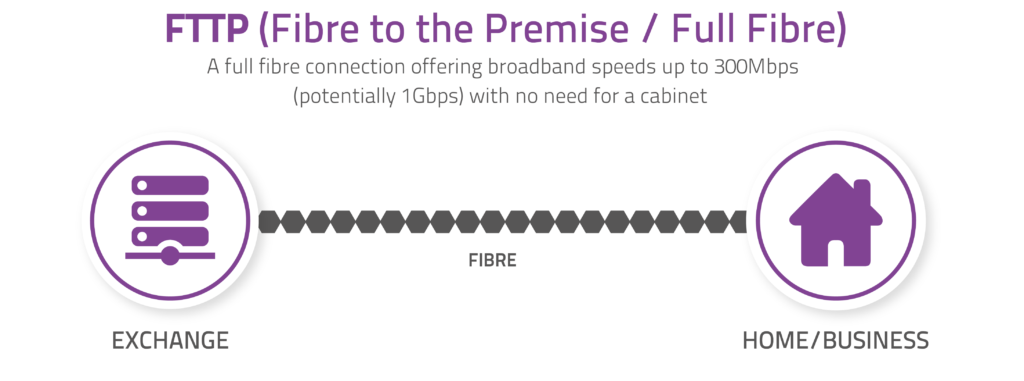
Fibre to the Premises (FTTP)
FTTP delivers fibre directly to your property, offering speeds up to 1Gbps. It’s future-proof for streaming, gaming, and business needs.
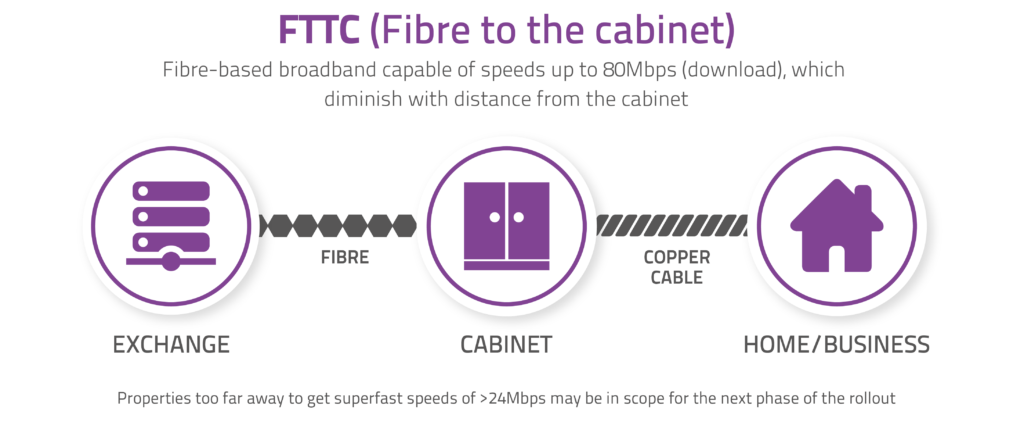
Fibre to the Cabinet (FTTC)
FTTC uses fibre to your local street cabinet and copper cables to your home. Speeds typically range from 24Mbps to 80Mbps. FTTC is being phased out as FTTP becomes more widely available.
More information about FTTP, FTTC and broadband in general can be found on our Broadband FAQs page.
Other broadband options
Click on the expandable buttons at the bottom of the page to find out more about each technology:
Mobile broadband
Uses 4G or 5G networks to provide internet access via a router or hotspot. Ideal for flexible or temporary solutions.
Wireless broadband (Fixed Wireless Access)
Delivers connectivity via radio signals from a nearby mast. Common in rural areas where laying fibre is difficult.
Satellite broadband
Satellite broadband is emerging as a powerful solution for homes and businesses in hard-to-reach areas where traditional fibre or mobile coverage can be challenging. Recent partnerships between leading providers and Starlink are paving the way for faster, more reliable connectivity across rural parts of the UK.
Why satellite broadband?
- Ideal for premises with very low speeds or where fibre rollout is not yet planned.
- Quick to deploy – no need for extensive ground infrastructure.
- Provides a viable alternative for those who may have been hesitant about standalone satellite services.
New partnerships
- BT/EE and Starlink: Working together to deliver high-speed home broadband to the UK’s hardest-to-reach places. Read more on the BT website. https://newsroom.bt.com/bt-group-and-starlink-pave-the-way-for-high-speed-home-broadband-in-the-uks-hardest-to-reach-places/
- Virgin Media O2 and Starlink: A landmark partnership to boost rural mobile coverage and improve connectivity options. Read more: https://news.virginmediao2.co.uk/virgin-media-o2-signs-landmark-partnership-with-starlink-to-boost-rural-uk-mobile-coverage/
Want to be part of a pilot? You can register your interest through the provider pages:
- BT/EE Satellite Broadband: https://ee.co.uk/broadband/satellite-broadband
- Virgin Media O2 Satellite Connectivity: https://www.o2.co.uk/satellite
Learn more about Starlink
Visit Starlink for details on their satellite service: https://starlink.com/
Mobile broadband coverage is always improving and is one of the most accessible alternative solutions to getting a better broadband when fibre isn’t available.
Mobile broadband also has the added benefit of not being tied down to your property so you can take it out and about.
The 4G network currently covers 92% of the UK population and the average speed is 15Mbps (but capable of much faster speeds).
Mobile operators are also at the beginning of the rollout of 5G, which will provide faster mobile internet and more. We have more information on our Mobile pages.
If you use mobile broadband, check the coverage of your supplier. Maps can be found on supplier’s websites and overall mobile coverage can be found on the Ofcom website.
To check what mobile broadband packages are available you can use a comparison website such as Broadband Genie.
Wireless broadband offers high speeds without the need to lay infrastructure to your home.
Fibred-up to a local mast, the signal is then sent to a receiver at your home.
Wireless broadband is capable of high speeds with 40Mbps and higher available from many providers. It doesn’t suffer from latency issues (as with Satellite) and is fine for gaming and video calling.
Although not as widely available as some other alternative technologies, it is more common in rural areas where demand is high.
Some providers local to Cambridgeshire are:
For more information on this technology visit the ThinkBroadband website.
Satellite broadband is a widely available alternative solution for broadband and is now capable of speeds up 30Mbps – suitable for browsing the internet, reading your email, catch-up tv and video calls.
However, there are issues with latency due to the distance between the earth and the satellites – which affects fast paced online gaming.
Satellite broadband costs can vary and the installation of the equipment can be expensive, but some retailers will give you the installation for free if you sign up to a longer term contract. Use an independent online comparison website to find the best deal for you.
Find more information about satellite broadband on the ThinkBroadband website.
There are schemes available that you may wish to consider when looking to improve your current broadband connection. To find out more visit our Gigabit Broadband Voucher Scheme page.
Struggling with slow or unreliable broadband? You’re not alone – and there are solutions. Find out how to get better broadband on our Getting Better Broadband page.
